How to Use the Guide
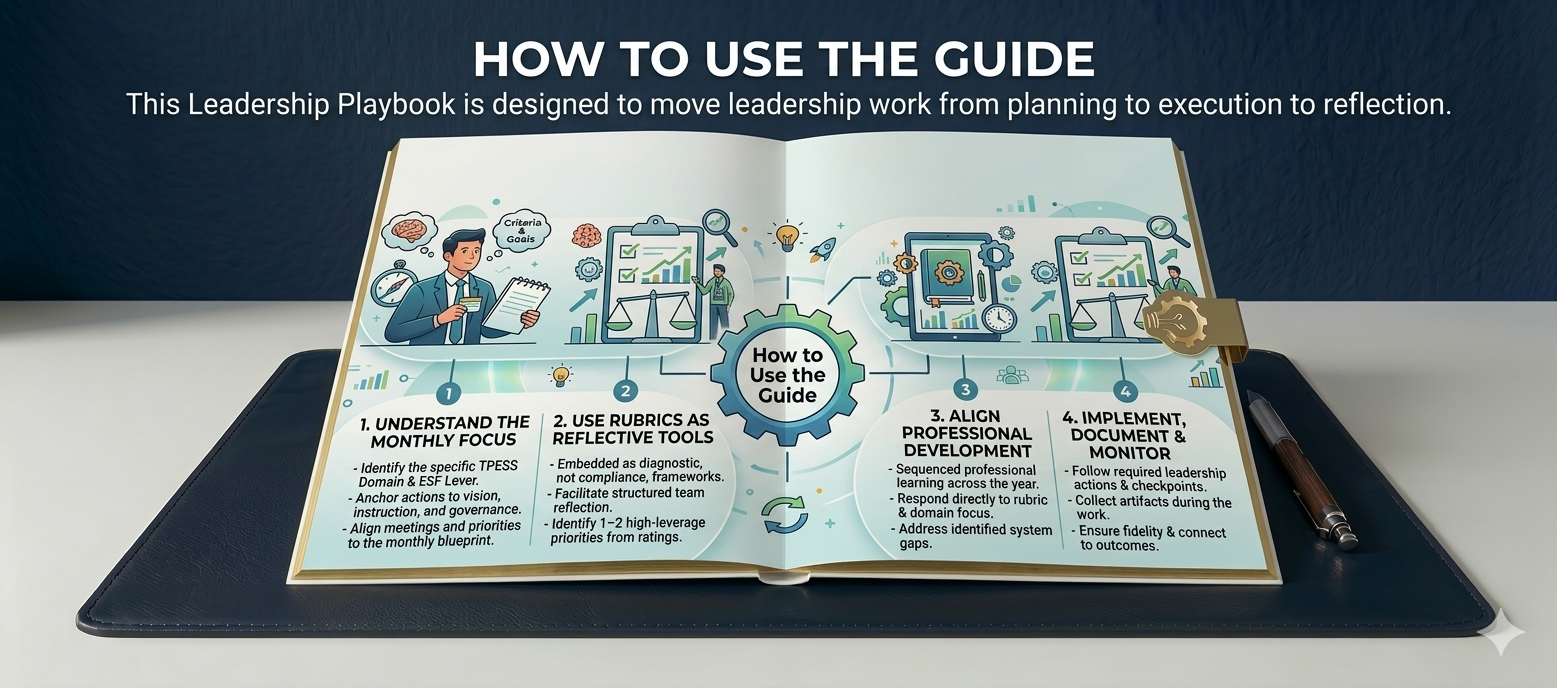
How to Use the Guide
This Leadership Playbook is organized by month to move leadership work from planning to implementation to reflection. Each month includes two aligned components:
Monthly Overview – Defines the purpose, TPESS/ESF alignment, key leadership questions, expected outcomes, and required deliverables.
Leadership Agenda – Provides a structured facilitation plan to guide leadership meetings and keep discussions focused on evidence and impact.
Together, these components ensure clarity, coherence, and accountability.
Step 1: Understand the Monthly Focus
Each month is aligned to specific TPESS Domains and ESF Levers to anchor leadership work to vision, instruction, governance, and accountability. This alignment guides leadership meetings, PLC priorities, data analysis, professional learning, and evaluation cycles.
Step 2: Use Rubrics for Reflection
The Lone Star Rubric and related indicators serve as diagnostic tools to support system improvement. Leaders should facilitate rubric reflection, calibrate ratings with evidence, identify 1–2 improvement priorities, and connect findings to CIP, PLC, and evaluation systems.
Step 3: Align Professional Development
Professional learning is intentionally sequenced throughout the year and aligned to monthly leadership priorities. PD should reinforce PLC practices, strengthen instructional consistency, support TTESS/TIA growth, and address needs identified through data and rubric reflection.
Step 4: Implement and Monitor
The Implementation Guide outlines required actions, checkpoints, artifacts, and compliance expectations. Leaders are responsible for maintaining documentation, ensuring fidelity of implementation, and connecting improvement decisions to measurable student outcomes.
When implemented with fidelity, the guide keeps leadership systems aligned, sustainable, and focused on instructional impact.